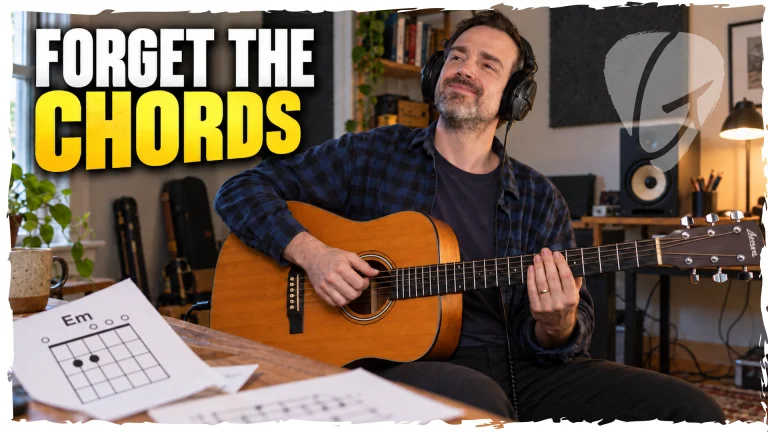
Basslines for Guitar – Add Riffs to Your Rhythm Playing (3 Famous Songs)
Learn how to add basslines to your guitar playing using 3 famous riffs. Improve syncopation, note control, and chord melody skills step by step.
Once you’re comfortable with the fundamentals – your basic chord shapes and strumming patterns – most players go in one of two directions.
Some start exploring lead guitar – scales and melody.
Others take their rhythm playing to the next level.
In this lesson, I show you how to do the second option in a way that is musical, practical, and actually fun.
We’re not doing boring drills.
We’re adding basslines to real songs – and learning the skills behind them so you can use them anywhere.

FREE PDF Songbook
Play 15 iconic songs on guitar — starting with just 2 chords
- Play your first complete song today – even as a total beginner
- Build real skills (chord switching, strumming, rhythm) through music you love
- Sound like a real guitarist from your very first practice session
Why Add Basslines to Your Guitar Playing?
When you add bass movement to chords, three big things happen:
- Your rhythm becomes stronger
- Your timing improves
- Your playing sounds fuller – especially on acoustic guitar
Instead of just strumming shapes, you start thinking about movement inside the chord.
This builds coordination between your fretting hand and picking hand and develops rhythmic awareness. If you’re curious about how rhythm and off-beat accents work in music, you can read more about syncopation here:
https://en.wikipedia.org/wiki/Syncopation
Understanding that concept alone will transform how you approach riffs.
Example 1 – Nirvana (MTV Unplugged Style)
I start with a riff inspired by Nirvana’s unplugged era.
The biggest technical takeaway here is syncopation.
This riff begins with a pickup note – meaning it starts before beat one. That alone can throw off your timing if you’re not used to it.
How I Practice It
I break it into two halves:
First half:
- 2nd fret on the thickest string
- Then open string notes
- Count everything carefully
Second half:
- Similar idea
- Focus on clean transitions
Then I add the pickup notes.
Instead of memorizing the entire riff at once, I loop each half separately. This is how you actually build skill instead of just copying shapes.
If you enjoy working on riffs like this, I also have a free lead guitar fundamentals ebook that walks through this stuff step by step in an organized way.
Example 2 – Seven Nation Army by The White Stripes
Most people play this riff exactly like the tab shows.
I don’t.
Instead, I adapt it for acoustic guitar by blending the bassline with chord strums.
Step 1 – Learn the Bassline Alone
- 2nd fret on the D string (twice)
- 5th fret
- Back to 2nd fret
- Open string
- Then switch to A string (3rd to 2nd fret)
I specifically use my ring finger on that 3rd fret so that when I add the C chord later, everything lines up easily.
Step 2 – Replace Notes with Chords
- First bass note becomes a down strum on the minor chord
- The 3rd fret on the A string becomes a full C chord
Now you’re not just playing a riff.
You’re playing chord melody – combining harmony and melody together.
This is a huge step forward in musicality.
Example 3 – The Joker by Steve Miller Band
This one is all about note duration.
Not just what you play – but how long you let it ring.
The magic comes from:
- Short, punchy notes
- Followed by longer sustained notes
- Controlled muting with the picking hand
For example:
- Pick the note
- Immediately mute it with the side of your picking hand or index finger
- Then let the next note ring
That small detail is what separates beginner playing from professional sounding rhythm work.
When someone can control note duration well, their playing sounds intentional and musical.
The Real Skill You’re Building
If I just told you:
“Play this, then this, then this…”
You might memorize it.
But you wouldn’t actually learn it.
Instead, I want you to:
- Break riffs into sections
- Loop small pieces
- Count out loud
- Control note length
- Add chords gradually
This step-by-step approach builds real rhythm confidence.
And that’s how you avoid becoming someone with a guitar collecting dust in the closet.
Ready to Go Further?
If you want a clear path forward:
- Start with my Free Crash Course to learn your first couple of songs the right way.
- When you’re ready to go deeper, check out The All-Access Pass – Your All-Access Pass to Mastering Guitar!
Inside the membership you get:
- On-demand access to my full course library
- Step-by-step programs for rhythm, lead, fingerstyle, and blues
- Exclusive bonuses that enhance YouTube lessons
- A private community for feedback and support
No more random YouTube rabbit holes. No more wasted time.
Everything is structured so you build real skills and actually enjoy the process.
👉 https://goodguitarist.com/premium-courses/
Have a fun time practicing and I’ll see you soon!
-James