How to Graduate From Beginner Guitar With Chord Embellishments
Ready to sound less like a beginner? Learn to add sus chords, ghost strums, and a lick to a simple progression and start playing intermediate guitar.
I’ll be honest with you – the terms beginner, intermediate, and advanced are kind of BS. But there is a real first step that takes you from strumming basic chords to sounding like an intermediate player, and in this lesson I’ll show you exactly what it is.
What “Beginner” and “Intermediate” Really Mean
To me, a beginner is someone working on chords and strumming – anywhere from just getting started to being a really solid strummer. An intermediate player is someone doing a little extra on top of that.
The good news is that the gap between them is smaller than it looks. You cross it by adding embellishments to chords you already know.
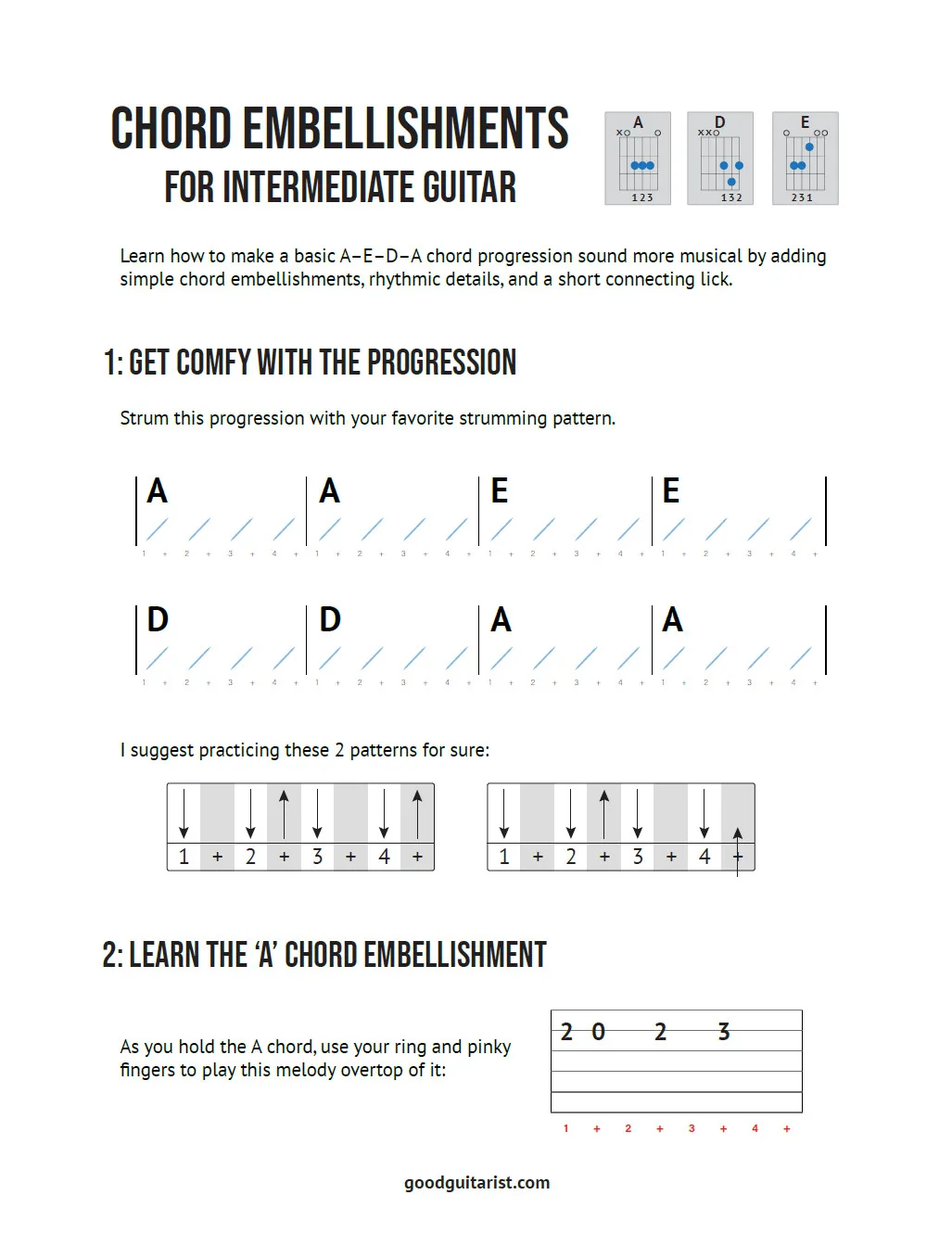
Get the Worksheet That Goes With This Lesson!
All-Access Members can download it instantly and follow along step-by-step.
Step One: Embellish a Simple Progression
We start with a classic three-chord progression: A to E to D and back to A. Then we make it interesting. On the A chord, lifting your ring finger opens up a suspended chord, and adding your pinky on the third fret creates a little melody – a sus2 down to the plain chord, up to a sus4.
We do the same idea on E and D, so each chord gets its own tiny melody instead of just sitting there.
Ghost Strums and Landing on Beat One
Your strumming arm is always moving down and up, even on the beats you don’t play. Instead of missing the strings on those, you can catch just the middle strings with a soft “ghost” strum to keep the rhythm alive.
At the end of each chord, lift your fingers early and strum the open strings on an upstroke. It sounds rough slowly, but up to speed it adds a cool lift and guarantees you land on the next chord right on beat one.

Practice the Concept, Not Just the Part
Here’s the part that actually matters: don’t just memorize this one progression. Break it into small pieces – just the A part, just the D part – and learn the idea behind it.
Take any chord, find a finger that’s free, decide which beats you’ll add it on, then count it out and add some strumming. That’s the whole method, and it works on every chord shape you know.
Final Thoughts
Pull off this one progression and you’ll have a template you can bring to everything you play. If you want the printable guide for this lesson plus a step-by-step path through all of it, it’s all inside my GoodGuitarist Academy, where you also get every course, play-alongs, and the chance to ask me questions directly.
Have a fun time practicing and I’ll see you soon!
-James