How to Learn the Guitar Fretboard: Unlock Lead Up the Neck
Learn the guitar fretboard the simple way. Start on the G string, memorize a few notes, and use one shape to play rhythm and lead all over the neck.
I don’t want to give you another hack you’ll forget in a couple of days. What I’m about to show you is simple – simple enough that you’ll be doing it by the end of this lesson – but it’s actually the foundation the whole CAGED system is built on. It’s how you finally start to understand the fretboard.
This Isn’t a Hack – It’s the Foundation
At its core, this is a two-step system. Step one is moving along the fretboard to find the key that matches the song. Step two is adding a shape that works as a chord and a scale at the same time.
If you’ve ever felt stuck soloing in the same low position, this is how you break out of it – without spending hours memorizing every scale shape like I did.
Get the Worksheet That Goes With This Lesson!
All-Access Members can download it instantly and follow along step-by-step.
Step One: Learn the Notes on the G String
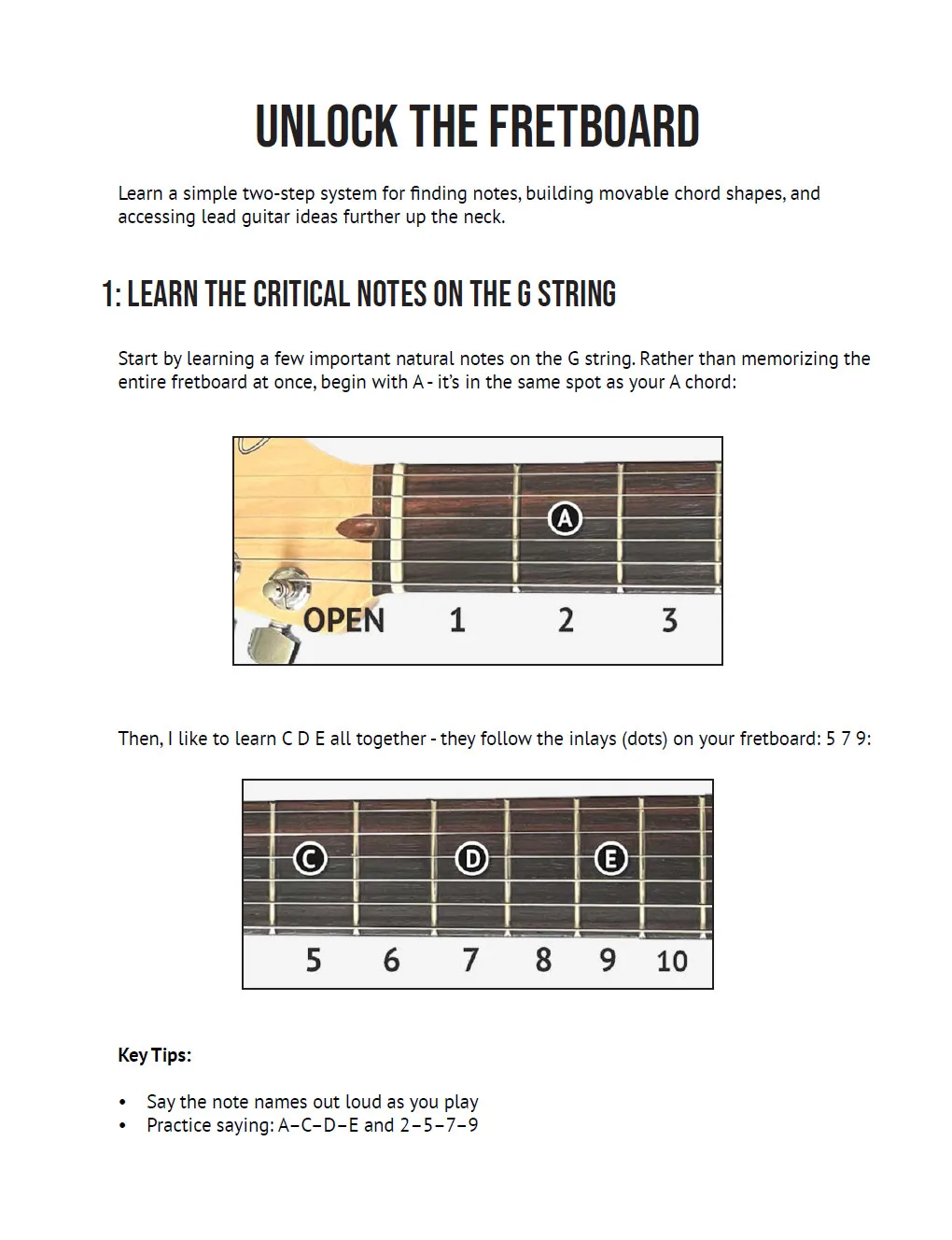
We start on the open G string. The second fret is A – easy to remember, because that’s where your A chord lives. Then follow the inlay dots up to the fifth, seventh, and ninth frets: C, D, and E.
Those three notes are the only thing you really need to brute-force memorize. Say them out loud with the fret numbers – “A, C, D, E… two, five, seven, nine” – and if you know the intro to “Layla,” you already know that exact sequence.
A Little Theory: The Musical Alphabet
The musical alphabet runs A, B, C, D, E, F, G and then starts over. Most notes are two frets apart, but there are two spots – B to C and E to F – that are only one fret apart.
Everything also repeats at the 12th fret, which is exactly one octave higher than your open strings. Learn the natural notes first, and sharps and flats are just one fret up or down from there.

Step Two: One Shape That’s a Chord and a Scale
Now take your open A chord shape and play it with a single flattened finger across the D, G, and B strings. Slide that shape to the notes you just learned and you get triads at the fifth, seventh, and ninth frets.
Your index finger is already sitting in the middle of the minor pentatonic scale, so adding your ring finger two frets higher gives you the scale right there too. One shape, rhythm and lead together.
Why Triads Are a Lead Player’s Best Friend
A lot of players treat barre chords as the big goal, but I reach for these triad shapes far more often in a band. They’re punchier, they cut through the mix, and they leave room for the rest of the music.
Once you can find the key and drop this shape in, you can jam along with almost anything.
Final Thoughts
Get comfortable with this one shape and the whole neck starts to open up. If you want the printable worksheet for this lesson and a step-by-step path that ties it all together, it’s waiting inside my Good Guitarist Academy, along with every course, play-alongs, and the chance to ask me questions directly.
Have a fun time practicing and I’ll see you soon!
-James