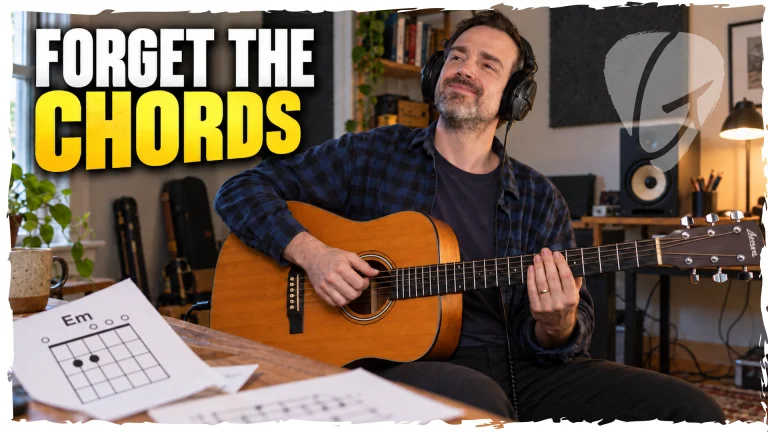
Strumming Tip for Beginners: Forget the Chords and Sound Confident
A simple strumming exercise for beginners: mute the strings, play along with a song you love, and learn to add real expression to your rhythm.
Today I want to share one of my biggest tips for strumming success – something that will help you move past the beginner stage and start sounding like a confident guitarist. And all you have to do is forget the chords and the notes.
I know that sounds strange, but hear me out. When you’re thinking about chord shapes, your whole body tenses up, and tension is the enemy of good rhythm. This exercise takes that weight off your mind so your strumming hand can finally relax and express itself.

1. Load Up a Song You Love
Pick any song you enjoy. This works best with headphones or a good stereo, because you really want to get lost in the music.
2. Mute the Strings and Play Down Strokes
Lightly rest your fretting hand across the strings to get that muted, percussive sound. Then play simple down strokes, trying to match the beat of the song.
Don’t think too hard. Focus more on listening to the song than on what you’re doing, and let your hand speed up or slow down until it locks in.
3. Find the Snare Drum
Now start listening for that snappy drum hit – the snare. In most songs it lands on beats 2 and 4, a pattern known as the backbeat. Let your hand hit a little harder on those moments while keeping the steady pace going.
You don’t need to count it. Just feel it.
4. Match the Tambourine with Up Strokes
If you hear a tambourine or shaker jingling faster than your down strokes, add up strokes to match it. Notice how small and tight that sound is, and make your strumming motion smaller and tighter to copy it.
5. Aim at the Bass Drum
When you hear the bass drum, aim your strokes at the thicker strings. Mixing thick-string hits with snare accents starts to sound like a real drum groove coming from your guitar.
6. Leave Some Space
When I experiment with this, one of the biggest improvements comes from playing less, not more. Leaving little gaps in your strumming adds far more than you’d think.
Final Thoughts
This is your chance to experiment in a musical setting with zero consequences – no chords, no notes, just rhythm. When I first tried this it didn’t sound great, but after just a few 10-minute sessions over two or three days, it really started to come together.
Always start with the basics: load up a track, play down strokes until they line up, add emphasis on the snare, and build from there. Listen first. The music will tell you what to play.
If you’d like a clear, step-by-step path that teaches the right things in the right order, come join me inside the Good Guitarist Academy and start your free trial today.
Have a fun time practicing and I’ll see you soon!
-James