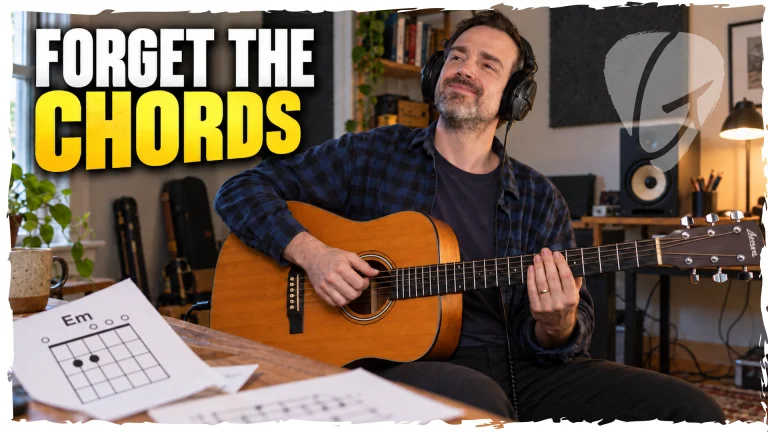
Top 5 Beginner Guitar Exercises for Smooth Playing
Struggling with sore fingers and choppy strumming? In this lesson I show you 5 simple beginner guitar exercises to build finger control, rhythm, and real musicality.
Top 5 Beginner Guitar Exercises for Smooth Playing
In the video at the top of this page I walk you through my top 5 beginner guitar exercises. These are designed to help you in three big ways:
- Get your fingers going where you want them to, quickly and accurately
- Develop solid rhythm so you actually sound musical
- Start building real musicianship, not just memorizing chord shapes
On this page, I’ll recap everything so you can follow along even if you are not watching the video.

Get the Worksheet That Goes With This Lesson!
Academy Members can download it instantly and follow along step-by-step.
Exercise 1: The All-In-One Finger Control Warmup
This first exercise is a classic finger workout, but I flip it around so you learn it in a way that actually fixes bad habits instead of creating them.
Most people teach it starting on the thickest string. I start you on the thinnest string instead:
- Pick any fret to start (I like the 5th fret).
- Place all four fingers on the same string:
- Index on fret 5
- Middle on fret 6
- Ring on fret 7
- Pinky on fret 8
- Keep all your fingers down. A lot of beginners put the pinky down and their index pops up. We want the opposite – everything stays close and relaxed.
- Pick the note under your pinky, lift it just a tiny bit, then ring, middle, index.
- Repeat on each string.
Tips:
- Only lift each finger as little as possible
- Focus on timing your picking and lifting together
- Adjust your thumb and elbow as you move to thicker strings
You can start with 2 or 3 fingers if you need to, then build up to all four.
Exercise 2: Downstroke Strumming With Songs (Rhythm Builder)
This one feels almost too simple, but if you do it every day for a week, your rhythm will improve a ton.
Here is what you do:
- Choose a song you enjoy.
- Lightly lay your fretting hand across the strings so they are muted.
- Play steady downstrokes along with the beat of the song.
To check your timing more precisely:
- Turn on a metronome
- Try to strum so your guitar sound and the click land exactly together
- When you nail it, the click almost disappears into your strumming
Once simple downstrokes feel good, try:
- Basic patterns
- Quieter/louder variations
- Matching the groove of the song more closely
This exercise will help you at any level.
Exercise 3: Silent Chord Switching
This one removes the pressure of strumming so you can focus only on your fingers.
- Choose an easy two-chord pair (Em to D6 or G to D works great).
- Set up your first chord.
- Without strumming, switch to the next chord as cleanly as possible.
- Repeat back and forth.
Tips:
- Notice which fingers can pivot or stay in place
- Move slowly and deliberately
- Think “lift, move, land”
Great for late-night practice since you don’t need to make any noise.
Exercise 4: The Chord Switching Game (Rhythm + Chords Together)
Learning chords and learning strumming separately is fine — but putting them together usually causes problems. This exercise bridges the gap.
Try it with two chords, like G and D:
- Strum G once on beat 1, then count “2 3 4” while switching to D.
- Strum D on the next beat 1, then switch back during “2 3 4.”
Once that’s easy:
- Strum on 1 and 2, switch on 3–4
- Strum on 1–3, switch on 4
- Spend more time strumming and less time switching
You can also use full progressions like G – D – C – G.
This trains your hands to switch chords inside a real groove.
Exercise 5: Play Simple Melodies By Ear
This might feel advanced, but it’s actually something you should start immediately. It’s the most important musicianship skill you can build.
Here’s the process:
- Spend 5 minutes trying to figure out a simple melody by ear.
- Start with something like Twinkle Twinkle.
- Pick a random starting note and ask yourself whether it’s right. If not, try again.
- When you find it, hunt for the next note… and the next.
At first this feels slow, but before long:
- You begin to feel whether the next note is “higher” or “lower”
- Big melodic jumps start to feel natural
- Your ear and fingers start working together
This pays off massively over time.
How To Use These 5 Exercises In A 20-Minute Practice Routine
Here’s a simple way to put them together:
- 5 minutes – Finger control warmup
- 5 minutes – Muted strumming with a song
- 5 minutes – Silent switching + Chord Switching Game
- 5 minutes – Melody by ear
No pressure to be perfect — just show up and stay consistent.